Immersive media refers to technologies and creative practices that merge the physical and digital—such as virtual reality (VR), augmented reality (AR), mixed reality (MR), and spatial audio—to produce deeply engaging, interactive experiences that broaden audience participation and reach. Its applications span the arts, entertainment, leisure, education, heritage preservation, tourism, and training in the green industries. Immersive media is also intrinsically connected to digital innovation, particularly within the broader field of artificial intelligence research.
The Immersive Media Port is a new, site-specific laboratory in Harwich—spanning Bathside and the Old Town—dedicated to experimental immersive media practices. It places equal emphasis on site-based research and a community-centred immersive knowledge transfer strategy. Skills, ideas, and cultural practices will be lived, shared, and experienced across both real and virtual environments, making learning a highly participatory, sensory, and collaborative act.
For Harwich, immersive media offers a pathway to future-proof the town’s cultural, natural, and socio-economic landscape. By equipping local communities with the skills, tools, and creative confidence to engage with these technologies, the Immersive Media Port will stimulate new forms of employment, cross-sector collaboration, and global connectivity. At the same time, it will provide innovative means to reinterpret Harwich’s unique history, ecology, and identity—bringing local narratives to global audiences while connecting global expertise with local communities.
Rooted in Harwich’s multi-layered history, ecology, and uneven technological development—where the rise of green energy coexists with persistent youth unemployment—the Immersive Media Port will merge innovative global research with immediate local benefit. It will operate as both a physical and digital hub, advancing research and practice in immersive media, the ethical use of digital technologies and AI in the creative industries, and community engagement. By bridging local and global divides in digital literacy, it will transform underused or marginalised spaces into experimental cultural zones.
Often overlooked despite its rich historical, natural, and geological significance, Harwich will be reframed as a threshold where local narratives meet global currents in art and technology, ecology and sustainability, history and migration. Rather than following the flow towards metropolitan centres, the Immersive Media Port will reverse this movement, creating decentralised, site-specific, and socially embedded growth through immersive media research and practice.
Three-Interfaced Media Port
The Immersive Media Port will operate through three interconnected interfaces:
- Digital Port (Online Research and Archive Platform) – Linking Harwich with the global community through accessible research, documentation, and creative exchange.
- Physical Port (Hybrid Media Lab) – A combined physical and digital space embedding global knowledge into the local environment via workshops, training, site-specific projects, and events, while disseminating locally generated insights worldwide. This community space will house technical equipment that is otherwise difficult for local people to access, such as high-performance gaming computers, VR headsets, AI software, and an extensive digital learning archive. While these resources are typically out of reach for the community, providing them in the form of a shared lab and learning space will open up transformative opportunities. Once accessible, they can support collective learning, skill development, and career growth with an impact that could be truly astonishing.
- International Residency Programme – Hosting international media practitioners for short to long-term stays, encouraging deep integration into the local community, and producing public-facing creative projects and training initiatives for immersive knowledge transfer. We will host the residents in a 100+-year-old house in Harwich, renovated according to sustainability principles, serving as a living embodiment of the Immersive Media Port project and reflecting its commitment to ecological and site-specific practice.
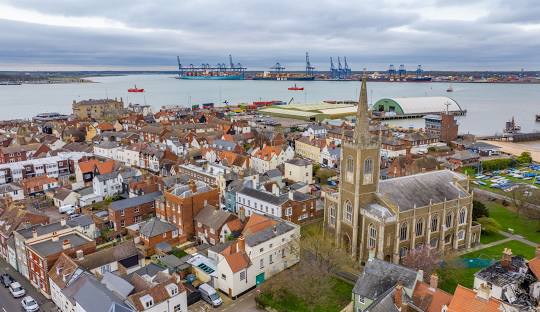
Harwich is a historic coastal town, a peninsula at the terminus of the direct London Liverpool Street–Harwich Old Town rail line, and a key maritime gateway to continental Europe via its direct passenger and car ferry connection to the Netherlands. It is one of the Haven ports on the North Sea coast and forms part of the UK’s officially designated Freeport East. Framed by the Stour nature reserves, Harwich also stands as the UK’s largest green energy hub. The town’s layered cultural heritage spans the Witch Heritage Trail, maritime history, Napoleonic forts, WWII coastal bunkers, and the Kindertransport—one of the most significant humanitarian actions of the 20th century, which holds urgent contemporary relevance.
Harwich’s unique geographical, economic, historical, natural, and cultural significance connects the Immersive Media Port project to local heritage, natural environments, historical consciousness, the community, and wider trade and transport networks. This positioning creates opportunities for cross-sector partnerships in media and cultural studies, community education, and socially, economically, and environmentally balanced sustainable development.
Despite its rich heritage, Harwich has faced economic precarity, underinvestment in socio-economic infrastructure, and limited access to advanced digital tools and training, resulting in youth unemployment and socio-economic inactivity. As of March 2024, approximately 67.7% of individuals aged 16–24 in the Harwich and North Essex constituency were economically inactive.* These figures indicate that a significant proportion of the town’s youth face barriers to employment and training opportunities.
The Immersive Media Port reframes Harwich not as a periphery but as a critical threshold—a liminal space where ideas, people, and stories converge. It will host residencies, workshops, exhibitions, events, and research and training programmes integrating immersive technologies with site-specific creative media, practical media skills education, historical and critical study, ecological awareness, and community well-being.
Located in Bathside, the historically underdeveloped transitional zone connecting the historic Old Town and Dovercourt—the two touristic conservation areas of Harwich—the Immersive Media Port will address socio-economic imbalances by creating connections between Bathside, Dovercourt, and Old Harwich. Through its residency, public education, research, and archive initiatives, the Port will attract international media expertise directly to Harwich, enabling a two-way immersive exchange of knowledge between local and global contexts through site-specific research and collaborative creation.
Current State: Pilot Residency
The international residency of the Immersive Media Port model is grounded in the conceptual framing of borderlands as thresholds, outsiders as socio-economic transformers, and the periphery as a connecting interface. The pre-pilot residency is undertaken by London-based, global x-media art and media lab initiative capitArtX. In January 2025, capitArtX launched a self-experimental residency at a 100-year-old historical house at Bathside to serve as the inaugural residency project and shape the foundational vision for the Immersive Media Port connecting Harwich to London and globally. As capitArtX, our approach has been to integrate deeply into Harwich life — building genuine, reciprocal connections with local residents and the town’s socio-economic, environmental, and historical layers. This project has been challenging the narratives that portray outsiders as divisive or extractive, instead positioning them as agents of transformation who generate socio-economic growth, mental well-being, and inclusive cultural exchange. It also decentralises immersive media research by rejecting the idea of the periphery as a degraded copy of cultural capitals, asserting instead its status as a unique, authentic, and vibrant zone of knowledge production. This initial mid-term self-residency was a methodological prototype. It includes:
- Renovating the Immersive Media Port’s residency house using salvaged and existing materials, embedding sustainability into the building’s evolving story, modifying the space to reduce energy/resource waste while ensuring safety and comfort for future residents.
- Establishing neighbourly networks to underpin future residents’ immersion in the community.
- Immersing in Harwich’s socio-economic layers and cultural and ecological narratives.
Socio-Economic Impact
The Immersive Media Port will:
- Equip underserved populations with digital and creative literacy
- Encourage transdisciplinary research across art, ecology, history, and technology
- Metabolise unresolved traumas (Kindertransport, COVID-19) through immersive storytelling
- Inspire sustainable cultural regeneration from within
- Build international networks grounded in local knowledge
By reimagining Bathside as a cultural interface, the Port will demonstrate that experimental, critical, and inclusive immersive practice can thrive at the margins.
The Controversial Banksy Mural as Immersive Intervention at the UK’s Edge
The Immersive Media Port is founded on the principle that immersion must begin in place before it can expand to media. This means living in, with, and through the neighbourhood — forming authentic, non-superficial relationships with residents and responding to local histories, struggles, and aspirations.
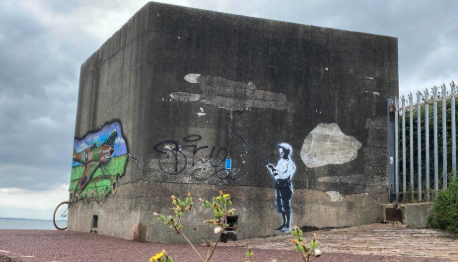
The pilot residency in Bathside will centre on an immersive intervention responding to the “controversial” Banksy mural in Harwich. This disputed work, painted on a WWII bunker at the edge of the peninsula and the UK, remains the subject of ongoing debate regarding its authenticity. Combining augmented reality, sound design, olfactory elements and archival media, the residency will serve as a proof of concept for the Immersive Media Port’s model—integrating immersive technologies with place-based storytelling, historical and technological reflection, and community co-creation.
Engaging directly with themes of authorship, authenticity, urban myth, and the afterlife of cultural memory, the project uses this visible yet unofficial mural as a focal point. The ambiguity surrounding its authorship resonates with the global condition of immersive and site-specific art today, particularly as rapid advances in digital technologies—most notably Artificial Intelligence—reshape traditional notions of art, authorship, and ownership.
The “controversial” Banksy mural addresses the pandemic as its central subject. The pilot residency will build an immersive intervention around this work, exploring the ambiguities of public memory and seeking alternatives to “social distancing” as a model of human survival.
Much like the unprocessed memory of the Kindertransport—a history that speaks simultaneously of thousands of children saved from state persecution and of the profound, lifelong rupture of separation from their parents—this project situates the pandemic within the wider frame of contemporary migration narratives. Both the Kindertransport and the pandemic are entangled with the earth and its inhabitants, and both remain metabolically unresolved within collective memory.
The mural’s ambiguous authorship provides a fitting entry point for reflecting on these immersive residues: the pandemic as a global trauma and the Kindertransport as one of history’s most striking socio-political terrors, where individual life was threatened by state oppression and execution. Each reveals moments of rupture and displacement in which lives and futures were determined by forces beyond individual control.
The Kindertransport narrative underscores the urgency of comprehensive hosting—a radical and compassionate practice of welcoming the displaced. In parallel, the pandemic compels us to imagine alternatives to isolation: new forms of connection and collective care that respond to the challenges of separation while engaging with the lived realities of migration and displacement today.
Together, these narratives—one historical, the other ecological—demonstrate that crises of mobility and survival demand imaginative social frameworks. Whether through sanctuary or through reimagined proximity, they call for practices rooted in empathy, resilience, and shared responsibility.
The resident artist-researcher will employ immersive media to engage with these unresolved local narratives, which resonate with global concerns—experimenting with how immersive art can help metabolise trauma, rebuild collective memory, and imagine more inclusive futures.
Selection of the Resident and Project of the Pilot Residency
The resident will be selected through an open call by a dedicated jury, including representatives of all stakeholders, based on the quality of their proposal and its effectiveness in engaging with the multi-dimensional layers of local history, environment, and community, ensuring full transparency, equity, and inclusivity.
More About the Mural and Banksy
The mural appeared during Banksy’s 2021 “Great British Spraycation,” when the artist announced he had left works along the coast. Tendring District Council, which governs the area including Harwich, placed the mural under protective glass. Yet doubts about its authenticity persist, and no further official action has been taken. This residency will approach the “controversial” Banksy not through the binary of ‘original’ versus ‘fake’, but as an entry point for broader discussions around authorship, authenticity, and the affective politics of immersive art.
Banksy’s practice is inherently site-specific, critically charged, and immersive—linking political “sites” to global discourses and acting as a transformative vector within human ecology. Crucially, it also challenges the binary of ‘original’ versus ‘fake’. While Banksy is known to claim certain works — often as a means of protecting them from removal, underpinned by the weight of their artistic and socio-political signature — they have never explicitly labelled a work as ‘fake’. This is a significant and overlooked point in the case of the Harwich mural. The residency will treat this mural as an immersive vector, expanding it into new layers and dimensions through immersive technologies. One reason for doubt about the mural’s authenticity lies in its location, as Banksy is known for selecting sites with clear conceptual intent. This residency will attempt to reframe the work as ‘original’ on its own terms by embedding new layers of meaning into its location—responding to and extending the logic of Banksy’s art.
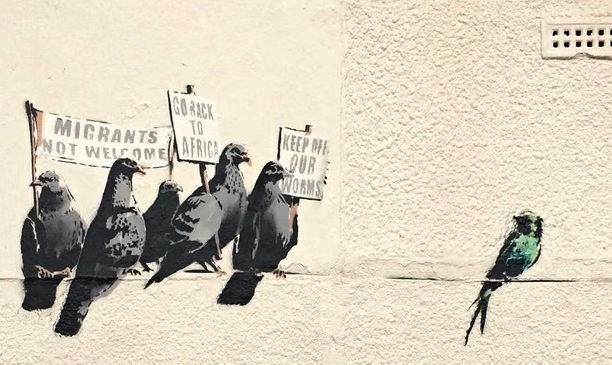
This artistic-political approach recalls a significant local precedent: in 2014, Tendring District Council removed a confirmed Banksy artwork after misreading it as “racist,” overlooking its critical commentary on immigration. Acting under their policy to remove offensive material within 48 hours, the council erased the piece and later invited the artist to create another work. This history adds resonance to the current intervention, making the act of reclaiming the mural’s identity as ‘Banksy’ central to the residency’s aims.