A residency on tradition, material heritage, and the Harwich Guy Carnival
Marcello Rotondo · Isil Ezgi Celik · Helen Spencer
Lasting isn’t stillness. It’s a bearing kept steady while everything around and within it continues to move. Thunder and wind is the image of lasting. The image doesn’t picture something still; it pictures two moving forces whose relation to each other stays constant even as each keeps moving. The image combines 心 (heart/mind, appearing in its compressed radical form 忄) with 亙 ( an old graph depicting the moon waxing and waning, or a boat moving steadily between two shores, between two points, moving). 恆 carries the lasting. Something is happening between two banks. The heart, and a cycle that returns to itself held together. Constancy built not from stillness but from a movement that keeps completing its own return. The outer form pictures motion. A moon’s phase, a crossing while what’s actually being named is what lasts across it.
What is tradition?
The question sounds abstract until it is put to a specific, living practice: Guy Carnival. One that has nearly died and been revived at least four times in its 170-year history, changed its name, its costumes, its targets of satire, and almost everything else about itself, while holding onto one recurring, hand-built object: the big head. Lasting takes the Harwich Guy Carnival’s big heads, first constructed in 1938 at Parkeston Quay from wire, brown paper, and papier-mâché by named workshop men, as its study, and asks a question that is at once historical, philosophical, and practical: what, exactly, is being carried forward when a tradition endures?
The residency brings together three distinct lines of inquiry, developed independently and in dialogue when possible, without aiming at resolving into a single position; for the aim of this residency is to answer what happens to “what exactly is being carried forward when a tradition endures”, when the residency’s question goes unasked.
Marcello Rotondo, (thinking)
Riflessioni intorno alle tradizioni | 伝統をめぐる考察 (Reflections on Tradition)
Isil Ezgi Celik, curator and researcher: I first encountered the big heads on the high street in my first year here, joined the carnival, and was totally captured by it. A year later, walking under the rain, I felt part of it. It was only now, in my third year, just before this year’s carnival, that I learnt the big heads carry a registered material heritage, and this despite already living here, working in art and culture, actively looking. That invisibility is itself worth noting: something can be formally protected and still remain unreachable, unknown even to those closest to it.
I approach the residency’s questions through the relationship between embodied practice and corporeal continuity. A craft technique (hands, local material, workshop lineage) is not incidental to a tradition’s meaning but constitutive of it, and this corporeal continuity is precisely what’s at risk when creative or administrative processes (algorithmic aesthetics, standardised outsourcing, well-intentioned equal treatment) replace it with something that only looks the same. My question: can a heritage practice survive being treated as one welcome option among others, or does that very equivalence quietly empty it of what made it heritage in the first place?
For the Guy Carnival to be genuinely inclusive, I think the big heads’ material heritage needs to be preserved first, so that it has the capacity to metabolise change rather than collapse under it. I hope to learn more about the paper-mâché technique itself, and to listen to the stories and to what has kept this material tradition alive.
I think this isn’t a question for institutions to settle alone. It belongs to everyone who has stood on around the high street or old town or has somewhat been captured by it.
Helen Spencer, Artist and Visual Director of the Harwich Festival
Helen thinks with the building, Harwich Arts and Heritage Centre, as much as with flow. Which room, which staircase, which passage feels right for which work, what a space remembers, what makes a place accessible not as policy but as felt, physical fact: a stairlift secured, a window finally repaired, a hall paced out and imagined full. Her question isn’t asked from a position outside the practice, weighing it up. It’s asked from inside the daily work of keeping spaces open, funded, and usable. How does a demanding, exacting material practice stay alive in public, without becoming spectacle, and without shutting out the very people whose presence has always been part of what kept it going?
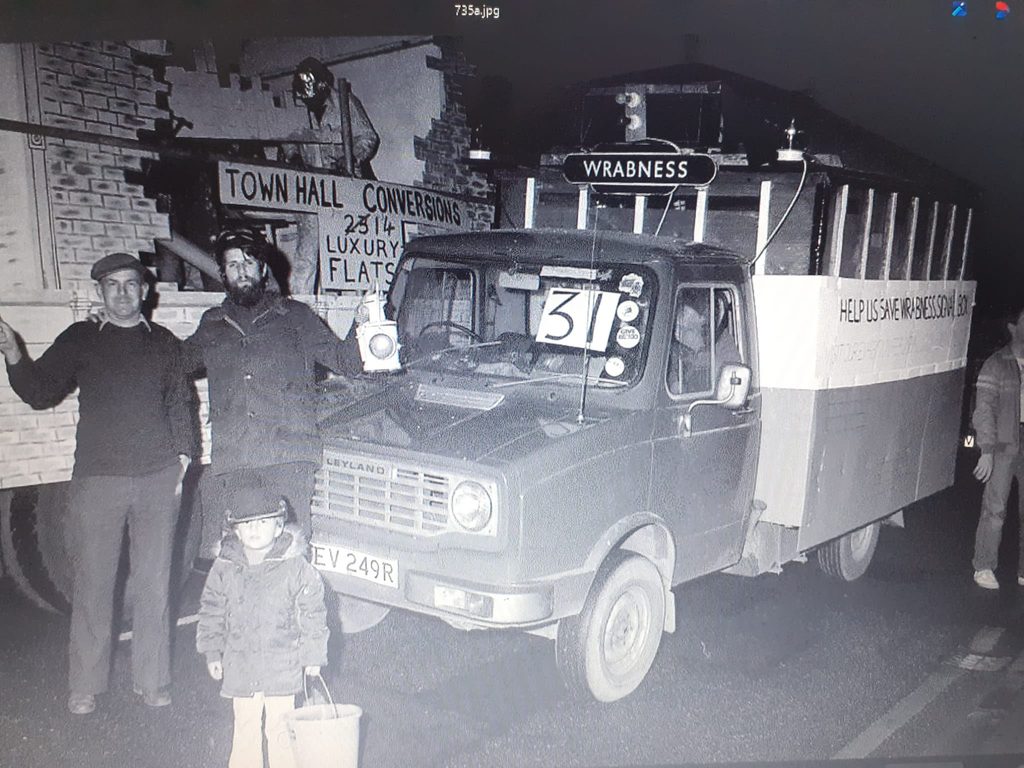
“It was a joyful protestation”, Helen
Together these three positions converge on the residency’s central inquiry: Should the big heads’ material heritage, the specific, hand-built, wire-and-papier-mâché method of making, be preserved as a defining constraint of the craft, or opened to other materials and techniques for wider participation, which has also, historically, been part of what the Guy Carnival means?
Lasting does not propose to settle this in advance. It proposes to research it in public, through correspondence, archival study, and direct engagement with the carnival’s own history of survival and reinvention. Testing, through this one town’s own object, whether a tradition’s endurance and its accessibility are in tension, or whether, properly understood, one has always been the condition of the other.
What does Guy Carnival mean to us?
What do we know about how the big heads are made?
Should the big head last as it’s always been made? Or is it allowed to change?
Here you can find a beautifully put history of the Guy Carnival.
Here you can join the conversation.
Lasting is a line of inquiry, so far, responded and backed by Harwich Arts and Heritage Centre, capitArtX as the host and Bread and Puppet Theatre.