“It was a joyful protestation”
Lasting
A residency on tradition, material heritage, and the Harwich Guy Carnival — with a living exhibition at the Harwich Arts and Heritage Centre, opening as dark falls on the last Saturday of October, and closing as dark falls on the last Saturday of October the following year.
Isil Ezgi Celik · Helen Spencer · Marcello Rotondo with guest residents Bread and Puppet Theatre, Harwich Arts and Heritage Centre, Christopher Root and many more to join.
What is tradition?
The question sounds abstract until it is put to a specific, living practice: Guy Carnival. One that has nearly died and been revived at least four times in its 170-year history, changed its name, its costumes, its targets of satire, and almost everything else about itself, while holding onto one recurring, hand-built object: the big head. Lasting takes the Harwich Guy Carnival’s big heads, first constructed around mid 20th century at Parkeston Quay from wire, and papier-mâché by named workshop hands, as its study, and asks a question that is at once historical, philosophical, and practical: what, exactly, is being carried forward when a tradition endures?
Isil Ezgi Celik
Director of the London-based art platform capitArt, and lead curator and researcher at capitArtX Immersive Media Port.
“I first encountered the big heads on the high street in Harwich, in the loan shop, where they were waiting to be picked up and worn at the carnival. In my first year here I borrowed my first big head and joined the carnival for the first time; I was totally captured by it. A year later, on carnival day, walking cold and damp and trying to manage two big heads, one of them now enormous, I felt it was no longer about the “fun” of the previous year, but that I was part of the carnival. It was only now, in my third year, a couple of months before this year’s carnival, that I learnt the big heads also carry a material heritage, and this despite already living here, working in art and culture, and actively looking. Something can be formally protected and still remain unreachable, unknown even to those closest to it.
I approach the residency’s question through the relationship between embodied practice and corporeal continuity. A craft technique (hands, local material, workshop lineage) is not incidental to a tradition’s meaning but constitutive of it, and this corporeal continuity is precisely what is at risk when creative or administrative processes (algorithmic aesthetics, standardised outsourcing, well-intentioned equal treatment) replace it with something that only looks the same. My question: can a heritage practice survive being treated as one welcome option among others, or does that very equivalence quietly empty it of what made it heritage in the first place?
I hope to learn more about the paper-mâché technique itself, and to listen to the stories and to what has kept this material tradition alive. I think this is not a question for institutions to settle alone. It belongs to everyone who has stood around the high street or old town, or has somehow been captured by it.” — Isil Ezgi Celik
Helen Spencer
Visual Director of the Harwich Festival
Helen thinks with the building, Harwich Arts and Heritage Centre, as much as with flow. Which room, which staircase, which passage feels right for which work, what a space remembers, what makes a place accessible not as policy but as felt, physical fact. Her question isn’t asked from a position outside the practice, weighing it up. It’s asked from inside the daily work of keeping spaces funded, and usable. How does a demanding, exacting material practice stay alive in public, without becoming spectacle, and without shutting out the very people whose presence has always been part of what kept it going?
Marcello Rotondo
Physics teacher and student of natural philosophy.
Marcello approaches tradition through the relation between spontaneity and time, the main recurrent themes of his research. No individual or community creates a tradition deliberately. Its source lies beyond individual intention and historical circumstance, although it becomes visible through particular objects, gestures and practices.
Time does not merely preserve these forms. It allows them to change while carrying forward what first gave them meaning. The authenticity of a tradition therefore lies not in the exact preservation of its appearance, but in its continuity with its source.
Marcello’s question: from what timeless source does tradition arise spontaneously, and how is it carried through time?
Reflections on Traditions|Riflessioni intorno alle tradizioni| 伝統をめぐる考察
Together these three positions converge on the residency’s central inquiry: Should the big heads’ material heritage, the specific, hand-built, wire-and-papier-mâché method of making, be preserved as a defining constraint of the craft, or opened to other materials and techniques for wider participation?
Lasting is a research residency project that proposes to research this in public, through correspondence, archival study, and direct engagement with the carnival’s own history of survival and reinvention. Testing, through this one town’s own object, whether a tradition’s endurance and its accessibility are in tension, or whether, properly understood, one has always been the condition of the other.
What does Guy Carnival mean to us?
What do we know about how the big heads are made?
Should the big head last as it’s always been made, or is it allowed to change?
Drop by Harwich Arts and Heritage Centre to join the year long Guy Carnival living exhibition starting from the last-Saturday of October after the dark falls to the last-Saturday of October after the dark falls next year.
EXHIBITION
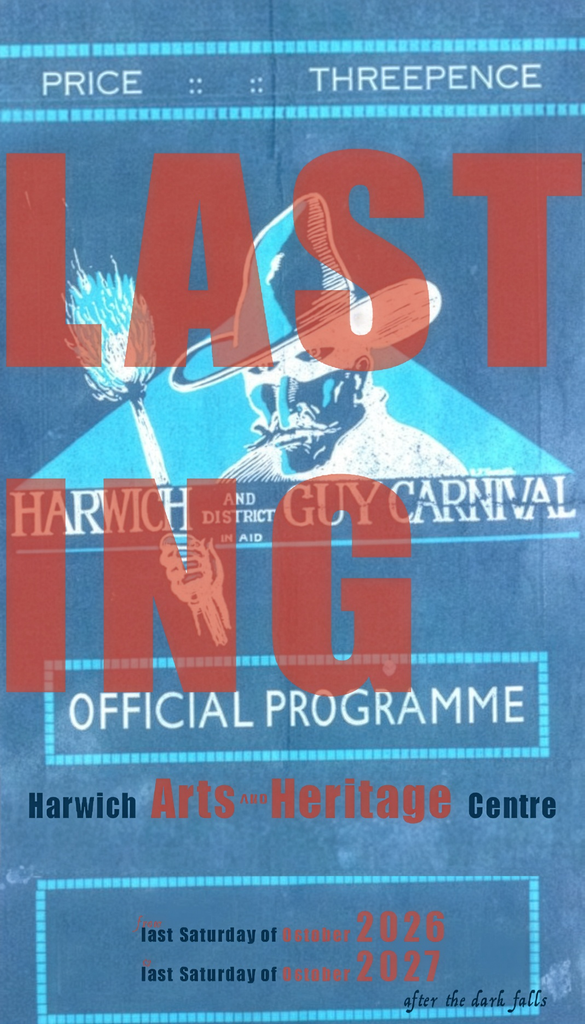
The original poster image was retrieved from the Harwich & Dovercourt website and has been digitally reorganised.
Lasting (恆 )isn’t stillness. It’s a bearing kept steady while everything around and within it continues to move. Lasting doesn’t picture something still; it pictures two moving forces whose relation to each other stays constant even as each keeps moving. Constancy built not from stillness but from a movement that keeps completing its own return. The outer form pictures motion while what’s actually being named is what lasts across it.
Big Head Workshop 2026
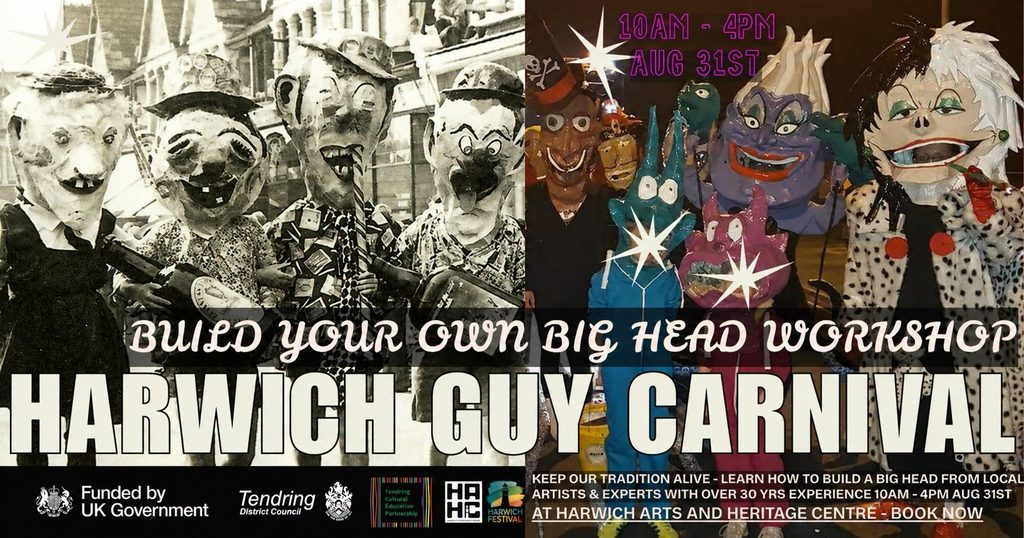
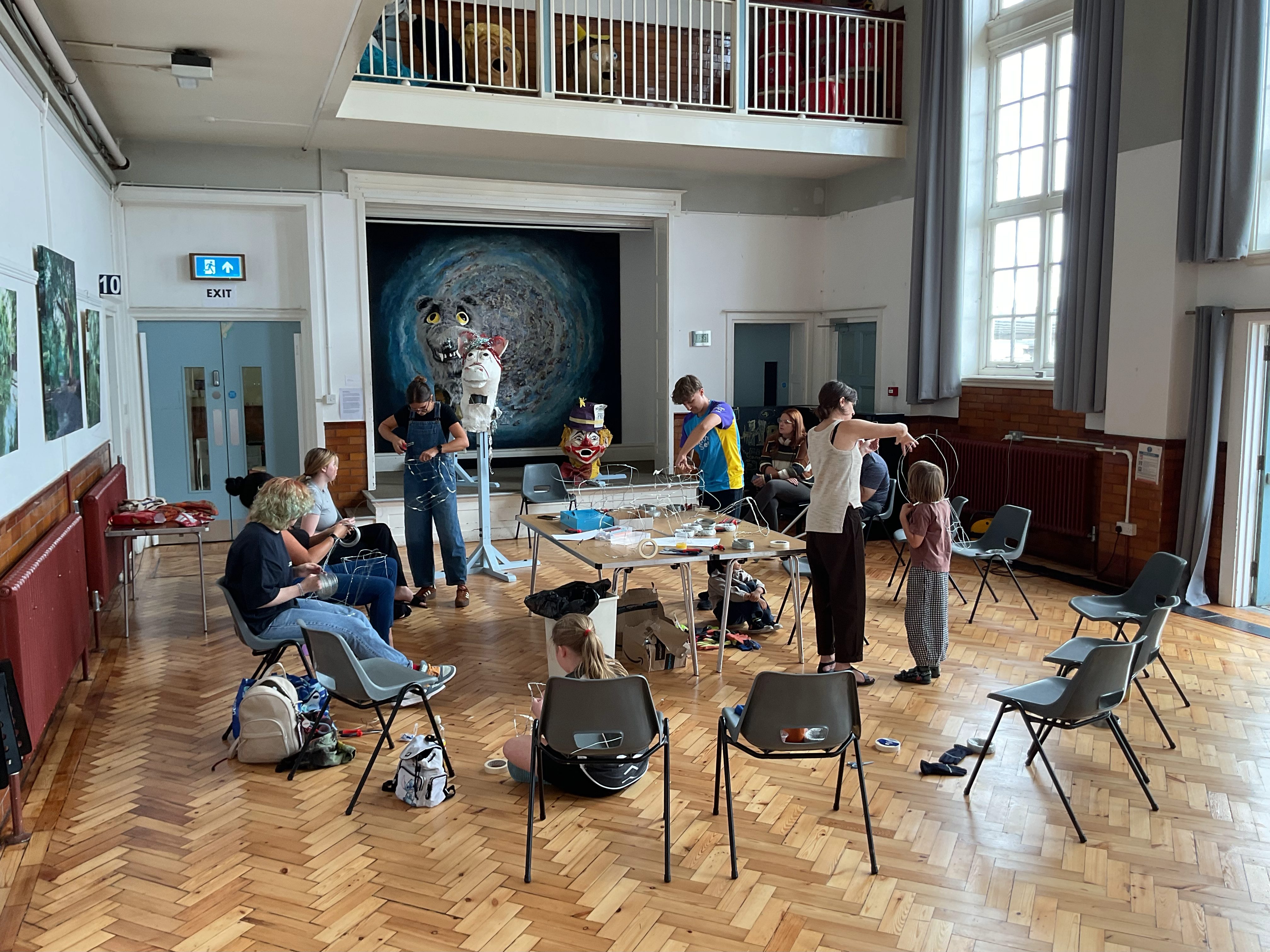
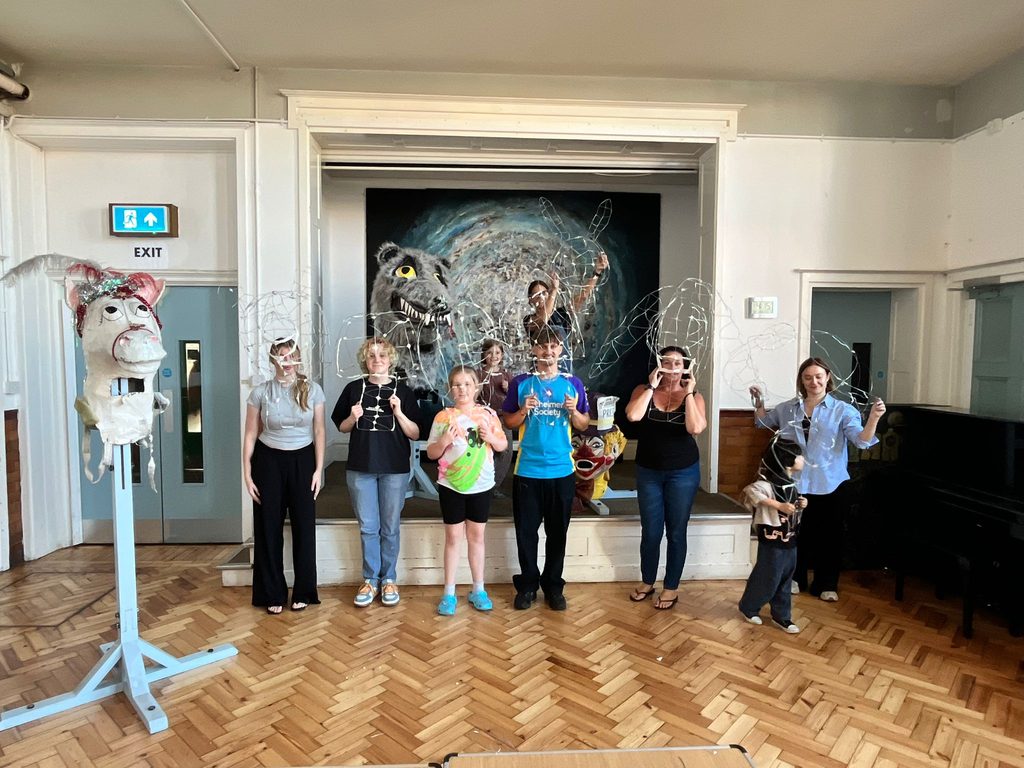
Big head making workshop part I creating the big head’s skull! at the HAHC, 31 August 2026.
GUEST RESIDENTS
Christopher Root
Author
Christopher has taken part in the town’s Guy Carnival for 36 years (missing only one, due to health reasons).
“I was also a torch-bearer one year. In 1996 I encouraged a group of mates to enter a float and, although we weren’t convinced we could manage it, we ended up gaining second place in the small groups category.” — Chris Root, Gazette & Essex County Standard
You can see Chris’s published book about the Guy Carnival, along with his historic big heads and decades-old stories and objects, at the Lasting exhibition throughout the year. Chris points out that Guy Carnival was always about “guying” — a satirical, good-humoured send-up of local or contemporary global figures, persons, or organisations, running throughout the festival — a practice that seems to struggle more than ever in the contemporary world.
Chris’s contribution to the residency is not archival. It is about remembering a past we never lived. It is about one of the most peculiar, intriguing, and spectacular aspects of the big heads’ guying character. It is about the cultural heritage of the big heads and the Guy Carnival.
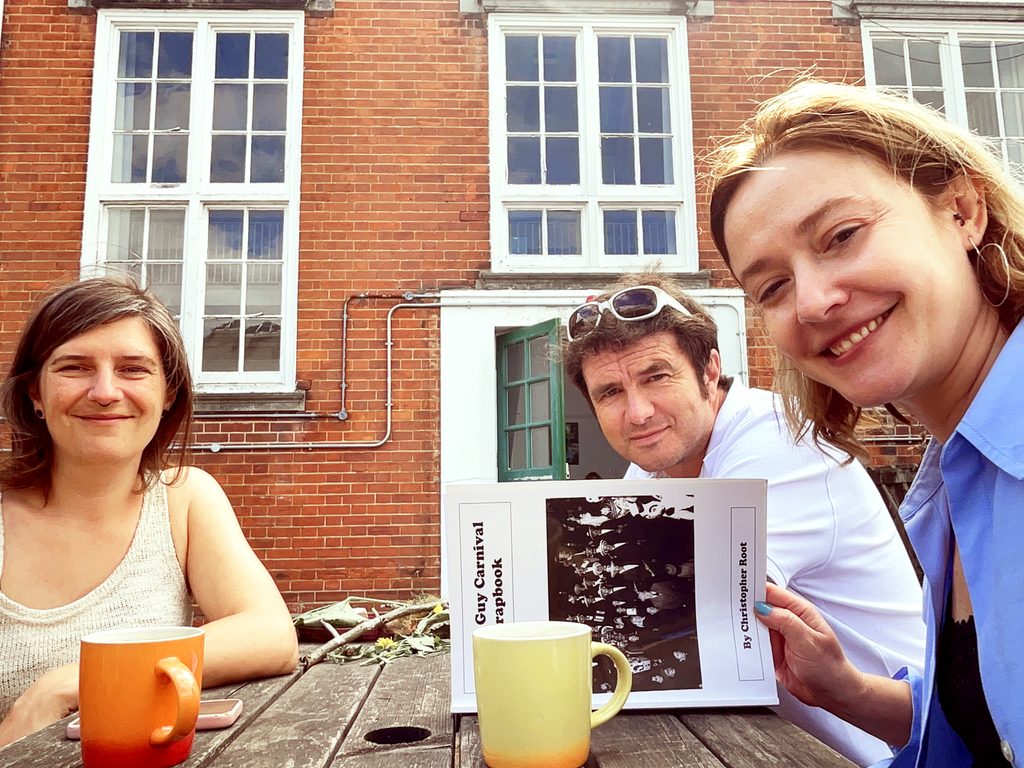
Helen, Chris, Isil at the big head making workshop part I at the HAHC delivered by Laura Taylor, 31 August 2026.
Chris’s contribution to the residency is not archival. It is about remembering a past we never lived. It is about one of the most peculiar, intriguing, and spectacular aspects of the big heads’ guying character. It is about the cultural heritage of the big heads and the Guy Carnival.
Bread & Puppet Theatre
In this video, Bread and Puppet Theatre explains how to make giant puppet heads and musical instruments with recycled materials that can be found in one’s immediate environment. The warmest thanks to our friends at Bread and Puppet, particularly to Hilal Akcan, for finding time for us during their touring season. We will be in dialogue with Bread and Puppet throughout the year, exchanging and discussing ideas. You can watch their online workshop below.
Online giant puppet heads making workshop with Bread and Puppet, 13 August 2026.
Here you can find a beautifully put history of the Guy Carnival.
Lasting is a line of inquiry, so far, responded and backed by capitArtX as the host organisationHarwich Arts and Heritage Centre, Bread and Puppet Theatre,.